


Malta’s National Gene Bank was established in 2024 with the aim to preserve and enhance the nation’s genetic heritage for present and future generations. At the heart of Malta’s commitment to safeguarding agricultural biodiversity, the National Gene Bank is tasked with:
• Long-term Conservation: We store seeds, plant reproductive material (PRM), and herbarium specimens, to ensure that Malta’s crop diversity is maintained for decades to come.
• Plant Characterisation: By studying the physical traits and genetic makeup of our collections, including keeping of records of genetic fingerprints and biochemical components, we help identify and understand unique qualities within local and traditional varieties.
• Supplying Material for Innovation: We provide samples to researchers, breeders, and conservationists, supporting projects that range from crop improvement to habitat restoration.
The diverse collections present within the National Gene Bank are crucial for sustainable development and help crops adapt to pests, diseases, and climate change. With 75% of global crop diversity lost in the last century, conserving indigenous varieties like the Bidni olive and Ġellewża grape preserves Malta’s agricultural heritage. Malta’s drought-tolerant crops also offer traits valuable for global agriculture. As a member of the International Treaty on Plant Genetic Resources for Food and Agriculture (ITPGRFA), the Commission on Genetic Resources for Food and Agriculture (CGRFA) and its various thematic bodies, and the European Cooperative Programme for Plant Genetic Resources (ECPGR), Malta’s Genebank plays an essential role in safeguarding Mediterranean plant genetic resources, studying them further to elucidate their actual or potential value, and making them available to plant breeders, farmers, and researchers to support crop improvement and promote genetic diversity.
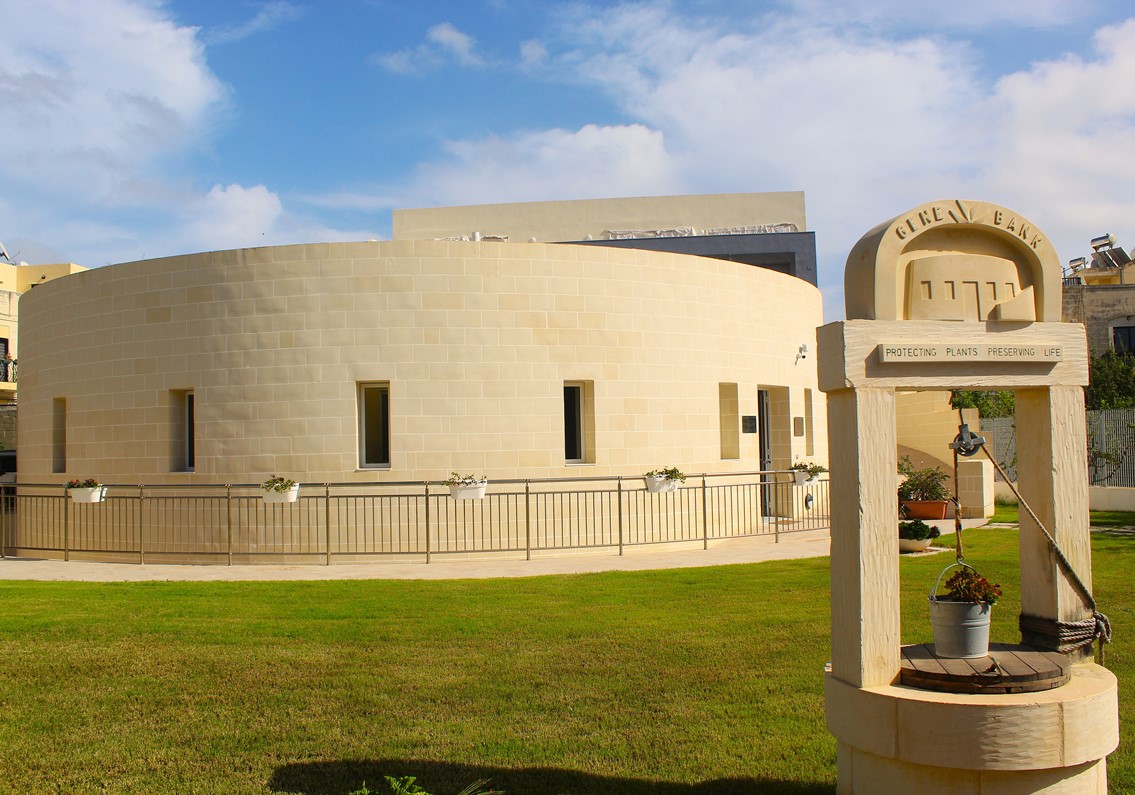
The establishment of a National Gene Bank for the conservation of indigenous and endemic plants was financially supported through the EAFRD and the implementation of Sub-Measure 10.2 of the Rural Development Programme for Malta for the programming period 2014-2020. More information on this project can be viewed by watching this short video.
Some of the deliverables of this project include:
• Establishment of climate-controlled rooms for the short-term and medium/long-term ex situ conservation of plant seeds, and for the storage of plant herbaria to be linked with each stored germplasm collection.
• Establishment of a molecular laboratory for the identification and documentation of collected germplasm.
• Services for the sequencing of germplasm stored within the gene bank to spearhead a large-scale documentation exercise of Malta’s germplasm for the scope of valorisation, research and development.
• Whole genome sequencing of two Maltese endemic pollinator plants: Cheirolophus crassifolius and Anthyllis hermanniae subsp. melitensis.

The RASD conducted an information campaign in 2025 titled GENE. The purpose of the campaign is to inform the public about conservation in agriculture, promote cooperation, and communicate plans regarding the establishment of a national gene bank and the role of the tissue culture laboratory in conserving plants relevant to agriculture. In its second phase, the campaign will be engaging directly with farmers and agricultural enthusiasts to identify landraces that may be included in the collections of the national gene bank.
Established in the early 1990s, the Plant Biotechnology Laboratory (also known as the Tissue Culture Laboratory) was initially set up to provide sanitised plant clones for agricultural use across Malta. This advanced technique offers several key advantages:
• Production of disease-free, genetically true-to-type plants, ensuring high-quality and reliable stock.
• Rapid multiplication of plant material, with the potential to generate thousands of plants from a single sample.
• Conservation of species that cannot be effectively preserved by seed, particularly vegetatively propagated crops like olives and citrus.
Since its establishment, the laboratory has supported the production of rootstock for stone fruit trees, such as GF677 and Myrobalan29C, bolstering local orchard resilience. Over the recent years it has also been pivotal in rescuing local red and white mulberry populations following pest outbreaks and propagating endangered pollinator species, including Cheirolophus crassifolius and Anthyllis hermanniae. With the advent of the National Gene Bank, the laboratory’s responsibilities have broadened beyond producing virus-free clones in accordance with EU regulations. Today, it not only supplies tissue samples to the National Gene Bank for long-term clonal landrace storage in liquid nitrogen but also undertakes research to develop and optimise propagation protocols. These protocols are vital for regeneration efforts and the conservation of sensitive plant populations that are of direct or indirect importance to agriculture.
The Agricultural Analysis Laboratory, which is located at the Agriculture Research and Innovation Hub at Għammieri (Marsa), was set up more than 40 years ago to offer a service to the farming community. In 2020-2021, the laboratory was restructured in order to improve the service being provided due to the growing demand for soil and irrigation water testing.
Most of the soil samples are tested due to obligations of European Union schemes, including the Measure for the Implementation of a Soil Management and Conservation Plan on a parcel (AECC5), which involves the testing of organic matter in soil. Apart from this, tests are also carried out for the determination of NPK in soil, which results are used by the farmers for the application of fertilizers, according to the fertilizer plan. This plan is a legal obligation intended to prevent the excess application of fertilizers, thus protecting the groundwater from pollution caused by nitrates from agricultural sources. In addition, such good practice assists farmers to adequately plan and apply fertilizers with economic benefits.
The Agricultural Analysis Laboratory is continuously investing in new equipment to increase its testing capacity and continuously improve the service being provided to the farming community. Therefore, through this restructured laboratory, the Research and Advisory Services Directorate will continue helping farmers face production challenges in order to produce quality products, as well as to comply with environmental obligations.
Soil tests which are currently carried out at the Research Laboratories include:-
• pH
• Electrical conductivity
• Sodium (soluble)
• Chloride (soluble)
• Total Kjeldahl Nitrogen
• Nitrate-N
• Potassium (soluble)
• Phosphorus, Olsen (available)
• Moisture / Dry Matter
• Organic Carbon (Walkley & Black)
• Organic Matter (Loss on ignition)
• pH
• Electrical conductivity
• Sodium
• Chloride
• Nitrate-N
• Potassium
• Phosphorus, Olsen (orthophosphate)


This modern computer-controlled glasshouse was built through financial aid from the IV Italian financial protocol. It has a total area of 910 m2. Vents are opened and closed according to the required temperature and climatic conditions. The computer also regulates the functioning of the chiller and the boiler to keep the desired temperatures. It has shading facilities both on the inside and on the outside to control the light intensity.
Towards the centre of the Lija premises there is a shade house having a total area of 600 m2 which is utilised for the final stage of acclimatisation. After the plants are acclimatised in the glasshouse, they are taken to this shade house for hardening off prior to being transferred to the open environment.
The screen houses having a total area of 429m2, are used for the conservation of mother stocks to prevent pest and disease infection. These are made of greenhouse frames covered by a double layer of net to prevent any invasion from insects.