The Agricultural Research and Innovation Hub (AgriHub), within the Ministry of Agriculture, Fisheries and Animal Rights, serves as a place where researchers, innovators, and farmers, both Maltese and foreign, work together to develop innovative agricultural practices. Part-financed by the European Union through the Rural Development Programme (2014-2020), the project saw its commencement in 2020. The AgriHub project brings together multiple entities with the Agriculture Directorate as project leader in collaboration with a team from the Malta College of Arts, Science and Technology (MCAST) and several scientists from the International Centre for Advanced Mediterranean Agronomic Studies, CIHEAM, Bari. Collaboration between local and international researchers is essential to create an environment of excellence that brings together people with new ideas and new knowledge.
As part of this project, 400 farmers participated in a technical questionnaire conducted by officials from the Directorate. The officials met the farmers personally and asked them questions about their crop management practices, from seeding to harvest. The questionnaire included inquiries about the pests and pathogens encountered by the farmers during the crop growth cycle. The objective of this study was to analyse the data collected and develop Integrated Pest Management (IPM) guidelines to assist farmers in sustainable crop management.
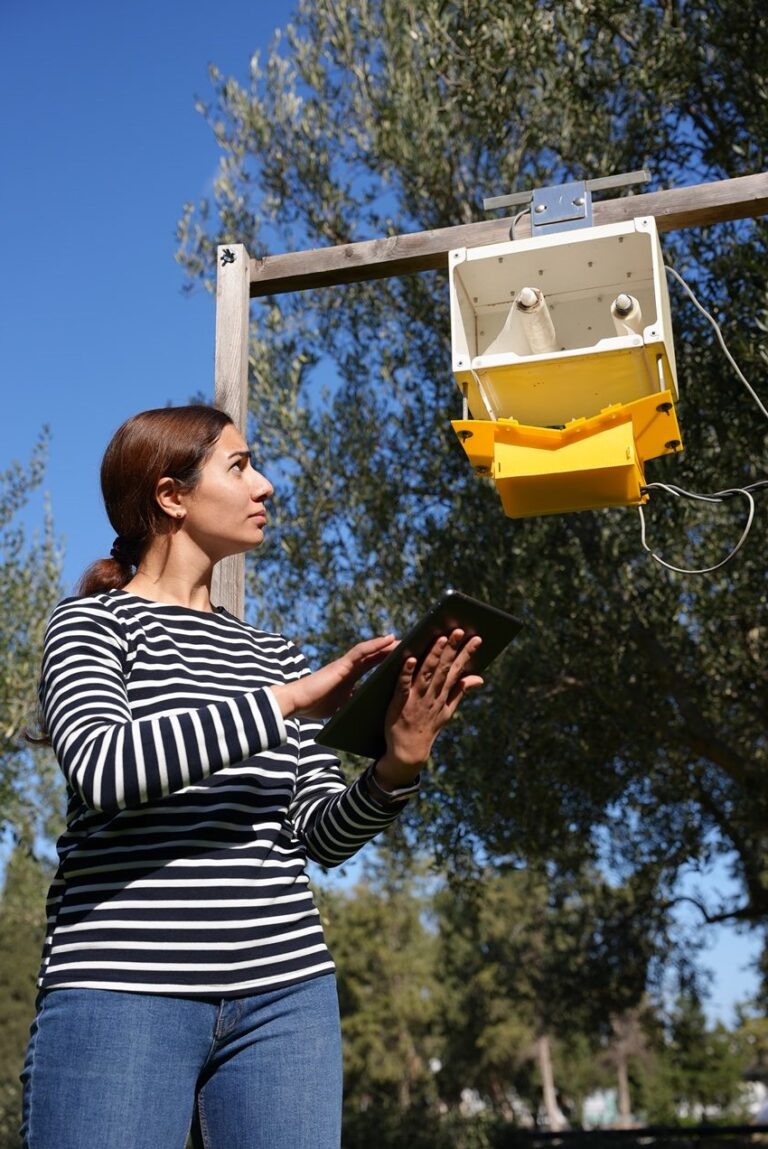
The government has made a strategic investment in innovative technologically enhanced traps available in the market. These traps are designed to streamline pest monitoring processes by incorporating innovative technologies and artificial intelligence. Powered by solar energy, these traps utilise pheromones to capture pests and provide daily pest count data, enabling the assessment of pest population severity. Additionally, the system integrates other relevant data parameters including weather and soil conditions. Accessible from various locations, including offices, this system allows for remote monitoring.
The Directorate is also in the process of developing computerised models (Pest Prediction Models) which will allow us to predict how certain pest populations will develop during the growing season of the crop. The pests that are being studied for now are Tuta absoluta (susa tat-tadam), Lobesia botrana (susa tad-dwieli), Bactrocera oleae (dubbiena taż-żebbuġ) and Phthorimaea operculella (susa tal-patata). Through the generation of the prediction models, the Directorate will be able to guide farmers on the ideal timing to take the necessary action to control the pest populations effectively and in a more sustainable manner.
The objective of this project is to develop and publish comprehensive integrated pest management (IPM) programmes for five key locally grown crops: tomatoes for processing, potatoes, strawberries, olives, and vines. A total of 29 IPM guidelines for various crops will be completed by the project’s conclusion, providing essential strategies for pest population control and crop protection. To date, eight document guidelines have been published, encompassing crops such as vines, wine and table grapes, olives, potatoes, tomatoes for both table and processing, and strawberries. Additionally, updated versions of guidelines for wine and table grapes, as well as olives, have been released. The forthcoming publication, nearing completion, focuses on citrus crops. These publications will subsequently undergo translation into Maltese.
The implementation of sustainable agricultural practices will be emphasised, utilising the IPM documents as a guide. This will involve a focus on precision farming techniques, including IPM and smart irrigation, with the aim of achieving several potential benefits. These benefits encompass increased crop yields, reduced costs and labour requirements, and optimisation of process inputs, ultimately leading to enhanced profitability. Moreover, precision farming practices contribute to improved work safety and reduced environmental impacts associated with agriculture, thereby promoting the overall sustainability of agricultural production. Following the development of the Pest Prediction Models and the initial batch of IPM-guideline documents, the testing phase of some IPM guidelines began, where farmers growing different crops were engaged in IPM trials. This consisted of having one tumolo of land cultivated under IPM guidelines in comparison to an equally large area being conventionally grown as the study’s control group. Until the start of 2024, the trials for tomatoes-for-processing and grapes were finalised, while the trials for potatoes and strawberries are currently ongoing. Trials for olive crops will be conducted at a later stage.
The silage project concept of fodder conservation and feed supply is to guarantee the productive function of animals in periods of scarcity, for small-scale farmers who can produce good silage in Maltese pedoclimatic conditions, with minimal resources. This project conducted trials of all stages of the entire operation to produce the silage. The observations are the result of two and a half years of research for silage production in the Maltese islands. The project has been selecting and cultivating different forage plants, different varieties and used different locations throughout the research period. A comprehensive and in-depth research paper is in the final stages and will soon be published.
Since the inception of this project, over 40 farmers and entities have already participated in the monitoring phase of this project. Currently, the aim is to continue performing additional monitoring on all the mentioned pests and engage more farmers and entities to help the Directorate obtain more data, which will fine-tune the models being developed.